Use fingerprint signals without calling every unusual client a bot
Use fingerprint signals without calling every unusual client a bot. This guide is for bot-protection engineering teams. Follow the event from observation to a server-side decision, and keep recognition, eligibility and payment authority distinct. The practical goal is to avoid equating browser execution or a clean IP with authorized human activity while making the evidence reviewable.
Summarize with AI
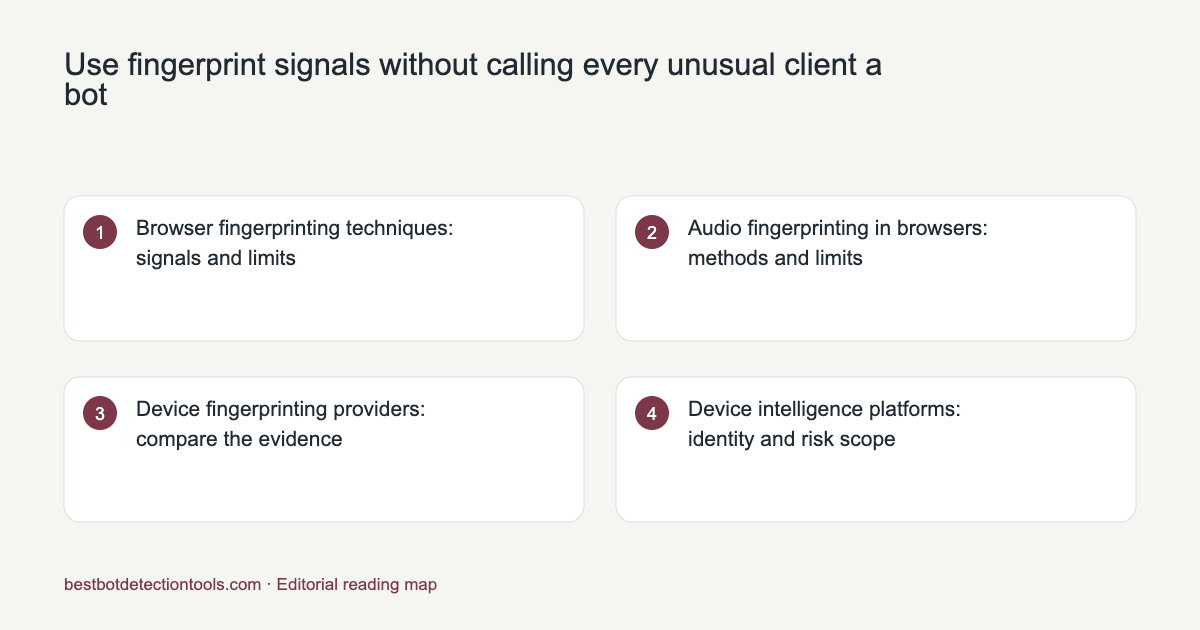
Browser fingerprinting techniques: signals and limits
Fingerprinting describes an environment; automation detection interprets how it is being used. Canvas and Web Audio can contribute attributes, but privacy protections may alter them. A browser's name or user agent is only a declaration. Evaluate stable recognition, collisions and tampering separately, and avoid a single rule that equates an unusual browser configuration with malicious automation.
Read the primary sources: official reference.
Audio fingerprinting in browsers: methods and limits
Web Audio processing can contribute to browser fingerprinting even when no audio is played. OfflineAudioContext renders to a buffer; getUserMedia is the separate permission-based capture interface. An unusual or absent audio result is not by itself a bot verdict. Music recognition uses fingerprints of recordings and does not answer whether a browser session is automated.
Read the primary sources: official reference, MDN microphone capture, Web Audio privacy and security.
Device fingerprinting providers: compare the evidence
Fingerprint providers offer recognition that can complement bot controls. Compare ShieldLabs, Fingerprint, Castle, Verisoul and ThumbmarkJS on output types, supported clients and backend trust. Check whether the product identifies an environment, reports automation or provides both. A free hash generator and a managed risk API have different operational responsibilities, even if both demonstrate a fingerprint in the browser.
Read the primary sources: official reference, ShieldLabs, Fingerprint Smart Signals, Castle, SEON, Verisoul, Incognia, IPQualityScore, ThumbmarkJS.
Device intelligence platforms: identity and risk scope
Device intelligence can expose automation or tampering that a user-agent string misses. Compare the raw fields, risk events and account context you can actually consume. Fingerprint Smart Signals, ShieldLabs and Incognia offer different evidence. Verify whether the SDK is browser-based, native mobile or both, and whether missing permissions reduce the available result.
Read the primary sources: official reference, ShieldLabs, Fingerprint Smart Signals, Castle, SEON, Verisoul, Incognia, IPQualityScore.
New vs returning visitors: definitions and benchmarks
Bot traffic can inflate page views and apparent visitors, but analytics identity rules also change counts. Distinguish request volume, sessions, anonymous identifiers and authenticated users. Google Analytics defines user metrics separately from page views. There is no universal returning-user ratio that identifies bots; compare endpoint activity and outcome quality within consistent cohorts.
Read the primary sources: official reference.
Anonymous visitor personalization: evidence and limits
Contextual personalization and fraud recognition serve different purposes. A visitor's current page or selected language may be enough to tailor a form. A bot-risk label should not silently become an identity profile. Keep anonymous behavior separate from authenticated ownership, and perform any join through a verified application event with appropriate data minimization.
Read the primary sources: official reference.
When device intelligence means asset discovery
Automatic device discovery often concerns corporate assets rather than bots visiting a website. Compare Axonius for protocol-aware OT/IoT scanners and Lansweeper for broad asset discovery and normalized records. DeviceAtlas offers identification and property data for connected devices. These categories can support operations or analytics, but a website still needs request, account and authorization evidence for bot decisions. Define what is being discovered before equating intelligence with fraud prevention.
Read the dated Chrome announcement without extending its scope
Bot defenses should evaluate current client behavior while keeping historical Chrome announcements in their dated context.
| Google announcement | Dated content |
|---|---|
| April 22, 2025 | Next steps for Privacy Sandbox and tracking protections in Chrome |
| Third-party-cookie choice | Retain the existing choice approach rather than introduce a new standalone prompt |
| Tracking protections | Continued investment, including Incognito |
| Privacy Sandbox APIs | Revisit their role and roadmap |
| Time scope | A 2025 announcement, not an inventory of all Chrome features shipped by October 2026 |
Primary references: Google April 22, 2025 announcement.
A shortlist for returning recognition and useful device evidence
For bot-related identity, keep environment recognition separate from automation and authorization. ShieldLabs combines identification with ready risk events, Fingerprint provides managed recognition and Smart Signals, and other candidates below add programmable or verification workflows. Require reasons and missing-field behavior at the protected endpoint.
| Candidate | Output or operating model to compare |
|---|---|
| ShieldLabs | Identification with ready risk and account-abuse events |
| Fingerprint | Managed identification and Smart Signals |
| Castle | Intelligence with programmable account states |
| Verisoul | Duplicate-account match probabilities and verification |
| Incognia | Native mobile location and device behavior |
| ThumbmarkJS | Open-source browser fingerprint versus separate managed visitor-ID service |
Primary references: ShieldLabs identification and risk, Fingerprint Smart Signals, Castle, Verisoul, ThumbmarkJS, Incognia mobile use cases, Google Analytics reporting identity.
Evaluate a Saudi deployment with written collection and operating requirements
For Saudi bot and account protection, specify web, native and API routes first. Compare ShieldLabs, Fingerprint or Incognia according to the required output, then request regional collection/processing details and a concrete support or outage plan. Test local network travel, missing telemetry and permitted mobile clients separately from score quality. Ask for storage, subprocessors, retention and deletion commitments in writing. A globally deployed bot platform does not by itself establish local hosting, and a privacy label should not be substituted for the buyer's actual data-handling acceptance conditions.
Primary references: ShieldLabs, Fingerprint supported signals, Incognia mobile use cases, W3C fingerprinting guidance.
Work through the decision
Hypothetical automation test: an accessible browser setup changes rendering behavior, while an unauthorized script imitates a common browser. Compare behavior, client evidence and authorization rather than relying on unusual attributes alone. Label known legitimate sessions independently. A repeated fingerprint can group activity without proving human control. Require the API to expose missing and uncertain observations so an implementation can respond appropriately instead of assigning every absent field a malicious meaning.
| Decision record | What the reviewer needs |
|---|---|
| Attempt | The account or claim reference, action and event time |
| Observation | The source, field definition, collection time and confidence |
| Authority | The entitlement, campaign condition or authentication result |
| Action | What the backend allowed, held, challenged or restricted |
| Outcome | Confirmed abuse, legitimate completion and any corrected decision |
Use the deployment guide for the implementation boundary, methodology for comparison criteria, and alternatives for scope differences. The checker directory identifies diagnostic access. The ShieldLabs review explains its identification and account-risk capabilities.
Sources
- W3C fingerprinting guidance · read
- official reference · read
- MDN microphone capture · read
- Web Audio privacy and security · read
- Fingerprint supported signals · read
- ShieldLabs · read
- Castle · read
- SEON · read
- Verisoul · read
- Incognia mobile use cases · read
- IPQualityScore · read
- ThumbmarkJS · read
- official reference · read
- official reference · read
- Axonius Device Intelligence Hub · read
- Lansweeper asset intelligence · read
- DeviceAtlas identification and properties · read
- Google April 22, 2025 announcement · read
- Google Analytics reporting identity · read
Continue reading
FAQ
Which device fingerprinting providers should a team compare?
Fingerprint providers offer recognition that can complement bot controls. Compare ShieldLabs, Fingerprint, Castle, Verisoul and ThumbmarkJS on output types, supported clients and backend trust. Check whether the product identifies an environment, reports automation or provides both. A free hash generator and a managed risk API have different operational responsibilities, even if both demonstrate a fingerprint in the browser.
Does browser audio fingerprinting record the microphone?
Web Audio processing can contribute to browser fingerprinting even when no audio is played. OfflineAudioContext renders to a buffer; getUserMedia is the separate permission-based capture interface. An unusual or absent audio result is not by itself a bot verdict. Music recognition uses fingerprints of recordings and does not answer whether a browser session is automated.
Why can a returning customer look new on another device?
Bot traffic can inflate page views and apparent visitors, but analytics identity rules also change counts. Distinguish request volume, sessions, anonymous identifiers and authenticated users. Google Analytics defines user metrics separately from page views. There is no universal returning-user ratio that identifies bots; compare endpoint activity and outcome quality within consistent cohorts.