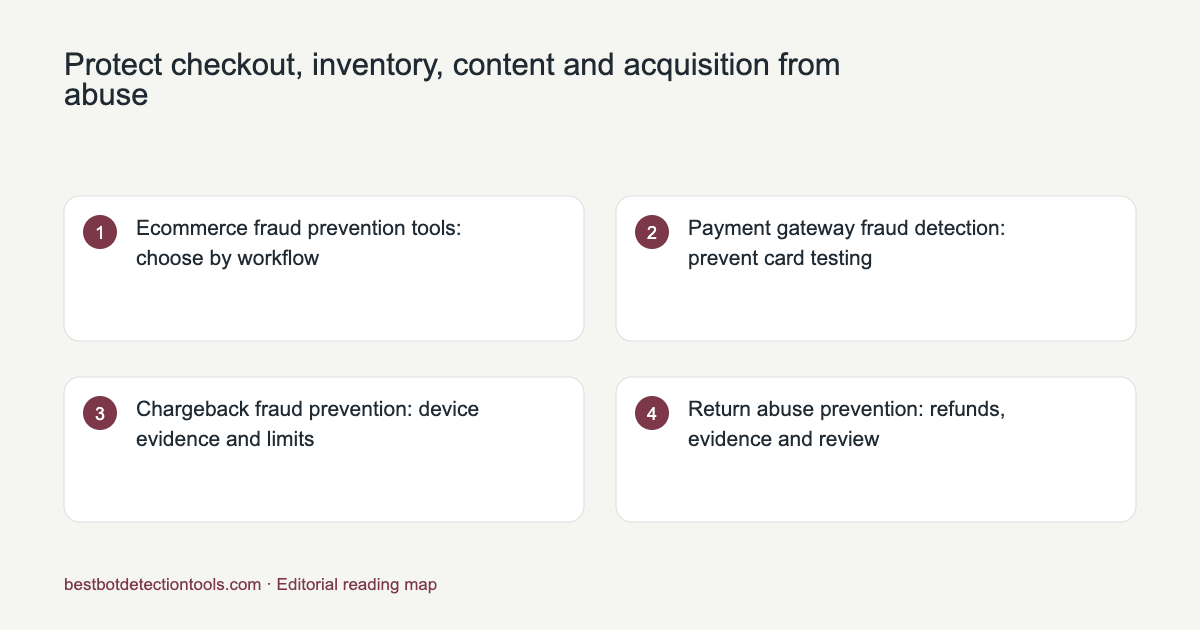
Protect checkout, inventory, content and acquisition from abuse
Protect checkout, inventory, content and acquisition from abuse. This guide is for bot-protection engineering teams. Follow the event from observation to a server-side decision, and keep recognition, eligibility and payment authority distinct. The practical goal is to avoid equating browser execution or a clean IP with authorized human activity while making the evidence reviewable.
Summarize with AI
Ecommerce fraud prevention tools: choose by workflow
Ecommerce bot defense protects a sequence of endpoints, from product access to payment and returns. Compare the full requested event coverage. Signifyd describes pre-account device signals and account-lifecycle protection, while Wyllo includes bots, resellers and policy abuse. Request action-level evidence and terms rather than assuming every commerce platform has the same native false-decline controls.
Read the primary sources: official reference, Wyllo.
Payment gateway fraud detection: prevent card testing
Payment bots can probe card details without using the normal checkout UI. Enforce controls on the payment endpoint, aggregate attempt velocity across account, device and transaction context, and use processor safeguards. A valid challenge token does not authorize the payment. Verify the integration with the processor's official test environment and avoid evaluating fraud tools by submitting arbitrary cards.
Read the primary sources: official reference.
Chargeback fraud prevention: device evidence and limits
Bot blocking may reduce some abusive payments but is not a chargeback guarantee. Preserve the transaction and fulfillment record with the relevant device evidence. Dispute prevention, response and contractual liability are different services. A network fraud report such as TC40 is not the same as a chargeback, and a detector cannot promise to block the existence of every later report.
Read the primary sources: official reference.
Return abuse prevention: refunds, evidence and review
Automated refund submissions are one form of abuse; repeated human claims require policy and fulfillment context too. Protect the endpoint, authenticate the account and record the order and reason. Refund APIs move funds but do not determine whether a customer is honest. Make the operation idempotent and preserve support's ability to reverse a mistaken restriction.
Read the primary sources: official reference.
Gift card fraud prevention: protect the value ledger
Gift-card bots often target balance lookups as well as checkout. Constrain repeated guesses across account, device and other relevant keys, limit information exposed in responses, and authorize redemption server-side. Update balances atomically. Blocking one browser pattern is insufficient when the API remains directly reachable or a human can reuse the same unrestricted endpoint.
Read the primary sources: official reference.
BNPL fraud prevention: credit, accounts and fulfillment
Bot controls help protect BNPL checkout endpoints but do not replace identity, financing or transaction assessment. Compare provider responsibilities, regional availability and dispute procedures. A successful challenge does not prove creditworthiness. Keep campaign bonuses and payment authorization separate so a repeated automated account cannot receive extra rewards merely by selecting another payment method.
Read the primary sources: official reference.
Synthetic identity fraud: proofing, signals and scope
Bot detection asks whether an interaction is automated; synthetic identity detection asks whether the asserted identity is fabricated. A human operator can use a synthetic identity, and an allowed bot can act for a genuine customer. Combine identity proofing, account behavior and device evidence as needed. A challenge result or browser hash cannot validate real-world identity attributes by itself.
Read the primary sources: official reference, NIST identity proofing.
Marketplace fraud prevention: profiles and transactions
Marketplace bots can create profiles, post reviews or manipulate inventory, but human coordination can produce the same harms. Protect the relevant action server-side and combine account, device and transaction evidence. Review authenticity requires more than detecting automation. A tool suited to login bots may not verify seller identity or inspect whether a review reflects a genuine purchase.
Read the primary sources: official reference.
Travel fraud prevention: bookings, changes and refunds
Travel bots can scrape fares, hold inventory or automate booking, while payment fraud uses a different decision boundary. Apply controls to each endpoint and compare device continuity with itinerary context. Ordinary travelers change networks frequently. A useful evaluation includes legitimate hotel and mobile sessions so an apparent improvement in bot blocking does not merely reflect rejected customers.
Read the primary sources: official reference.
Ticket scalping prevention: queues and purchase rules
Ticket bots target queues, reservations and checkout, so protect those server endpoints rather than only the event page. Make reservations time-bounded and inventory updates atomic. Review related accounts and manual bulk purchases as well as automation. A genuine-browser session can still violate purchase limits, and a signed ticket does not automatically make resale impossible.
Read the primary sources: official reference.
Paywall abuse prevention: entitlement and delivery checks
Bot controls can reduce automated extraction, but a paywall remains an authorization system. Do not send restricted content before checking entitlement or rely on a client-side overlay. Configure caches to avoid serving one subscriber's response to others. CAPTCHA validates a particular check, not subscription rights. Readers should use publisher-authorized subscriptions, trials or institutional access.
Read the primary sources: official reference, MDN cache controls.
Sybil attack prevention: identities, claims and limits
A bot can create Sybil identities, but Sybil coordination may also involve people. Identify the resource at risk: votes, rewards, account privileges or consensus influence. Combine automation evidence with eligibility and relationship review. One device is not one person, so an automatic ban on every shared browser would exclude genuine participants while still missing operators with several environments.
Read the primary sources: official reference.
Click farm detection: ad fraud, SIVT and measurement
Click farms can involve human interaction, so a bot detector cannot automatically certify advertising quality. Reconcile placements, clicks and server-confirmed outcomes, and distinguish invalid traffic from genuine but unqualified leads. IAB ads.txt and sellers.json help examine authorized supply chains. MRC's IVT framework adds category definitions; none of these alone proves every paid interaction belongs to a real prospective customer.
Read the primary sources: official reference, IAB sellers.json, MRC invalid traffic framework.
Affiliate fraud detection: qualify and reconcile claims
Affiliate bots can fabricate clicks or conversion calls, while human fraud can misattribute genuine orders. Verify the conversion on your server, authenticate callbacks and deduplicate payouts. Reconcile refunds and canceled subscriptions. Traffic classification helps investigation but cannot certify publisher credibility on its own; compare placement, attribution paths and the program's actual qualifying-event conditions.
Read the primary sources: official reference.
Compare self-serve TV reporting before interpreting fraud claims
CTV ad quality needs inventory and conversion evidence beyond web bot classifications. MNTN and Vibe are self-serve candidates. MNTN's reporting documentation gives a concrete export advantage: network reports and CSV, Excel or JSON output; some inventory has genre-only or Other Streaming Sources detail. Vibe offers campaign measurement but requires a comparable field and verification review. Ask both how IVT is excluded and disputed, and keep reported attribution distinct from directly observed fraud outcomes.
Account safety and on-chain attribution are separate investigations
A bot or device tool cannot guarantee that a third-party boosting service is account-safe. Riot's rules guidance warns about boosting and profile sharing, so prefer permitted coaching without transferring credentials. Crypto investigation needs another evidence layer: Chainalysis describes on-chain attribution and clustering, and Signals uses suspected labels with confidence. Require provenance and authorized access rather than assuming browser recognition or every blockchain platform provides communications intelligence.
Separate publisher attribution, audience authenticity and disclosure
Bot filtering and affiliate accounting should reinforce one another without sharing a vague clean-traffic label. A real person may still submit an ineligible lead, while an approved agent may assist a genuine customer.
| Source or record | Relevant scope |
|---|---|
| Modash | Creator and campaign tracking |
| AdPolice | Brand and affiliate monitoring |
| Japan Consumer Affairs Agency | Official stealth-marketing guidance; designation effective October 1, 2023, including advertising arranged through third parties |
| First-party qualification record | The actual application, purchase or hiring milestone required by the partner agreement |
Primary references: Japanese Consumer Affairs Agency stealth-marketing guidance, Modash campaign tracking, AdPolice affiliate monitoring.
Paper-check fraud calls for bank-side controls
Bot controls protect online endpoints, while paper-check fraud needs payment-instrument evidence. Compare your own bank services and reviewer responsibilities before treating a website fraud score as positive pay.
| Bank service | Documented model |
|---|---|
| Chase Check Protection/Positive Pay | Compares presented checks with issued-check details entered or uploaded by the business |
| Chase Check Monitoring | Review of outgoing checks at a selected amount threshold without an advance issue file; account availability varies |
| Bank of America Check Positive Pay fact sheet | Payee Positive Pay, Teller Positive Pay, reconciliation and exception handling, with service/market limitations |
| Buyer-specific contract fields | Issue-file format, payee matching, exception cutoff, default response and authorized reviewer roles |
Primary references: Chase business check protection, Bank of America Check Positive Pay fact sheet.
A purchase shortlist for guest orders and full customer journeys
For ecommerce teams replacing or complementing edge bot protection, keep request enforcement during migration. Compare ShieldLabs for account/visitor evidence with Signifyd, Wyllo, Sift or SEON for commerce workflows. Bot classification, payment authorization and contractual protection remain separate responsibilities.
| Need | Candidate scope |
|---|---|
| Visitor/account and promotion risk | ShieldLabs |
| Stripe payment rules | Stripe Radar |
| Broad commerce protection and contractual terms | Signifyd, Wyllo |
| Account/payment intelligence and operational workflows | Sift, SEON |
| Advertising IP, pre-bid/pre-click and post-bid IVT | Distinct Fraudlogix products |
Primary references: ShieldLabs, Signifyd, Wyllo, Sift, SEON, Stripe Radar, Fraudlogix.
Compare display and affiliate validation within the right regional cohort
Bot-free traffic and valid advertising measurement are different targets. HUMAN and Fraudlogix are relevant ad-specialist comparisons, with Fraudlogix separating IP checks, pre-bid/pre-click blocking and post-bid IVT. MRC's GIVT category uses routine filtration; SIVT requires deeper corroborated analysis. Compare equivalent inventory and fields, not blocked-request totals from unlike products. Include regional mobile, privacy and accessibility traffic in the legitimate cohort. For affiliate payments, verify the qualifying conversion after the click; for display, evaluate the measured impression. Preserve missing readings instead of silently declaring them valid.
Primary references: Fraudlogix advertising product families, HUMAN advertising protection, MRC invalid-traffic definitions.
Sports-betting click protection and player location have different jobs
A betting site's bot controls protect endpoints, while HUMAN or Fraudlogix can supply a specialized advertising-validation layer. Compare what happens to purchased impressions and clicks before joining them to verified signups or other qualified outcomes. A human click can still be low-quality, and an automated check is not a location license. Keep player-location assurance and wagering authorization in a separate control path with its own supported clients. This prevents a bot or proxy score from being reused as evidence for a decision it was not designed to make.
Primary references: HUMAN advertising protection, Fraudlogix advertising intelligence, Incognia location/device use cases.
Buy fraud prevention or contractual protection, not suppression of issuer reports
Bot prevention can stop some risky payments before they happen; it does not grant control over later issuer reports. Stripe identifies TC40-derived early warnings separately from chargebacks. Keep the account, bot and payment evidence attached to the order so reports inform subsequent policies. For loss coverage, inspect a separate agreement: Razorpay Shield has enrollment, transaction, fraud-reason and merchant-obligation conditions, with exclusions and a ceiling. Compare the actual coverage to the payment route instead of describing a bot control or liability product as a universal way to block TC40 messages.
Primary references: Stripe monitoring-program definitions, Razorpay Shield program terms.
Evaluate account safety through game rules and retained control
Bot-like activity and human account boosting are different questions. Riot's account-protection guidance warns against boosting, trading and profile sharing. A player can assess assistance by retaining login/recovery control and choosing game-permitted coaching instead of transferring the account. A protection system should then evaluate the observed action and permissions, not automatically call every second environment a takeover. Passing a bot check cannot make a prohibited service safe, and an automation detector should not be presented as an account-safety certificate for a seller.
Primary references: Riot account-protection guidance.
Work through the decision
Hypothetical inventory bot: an automated client reserves tickets, completes a browser challenge and retries checkout. The backend must still enforce reservation expiry, purchase limits and atomic inventory updates. Payment authorization, transfer policy and later disputes are separate stages. Include a genuine group purchase in the test cohort. Fewer page requests alone does not demonstrate reduced scalping if the protected purchase API remains open.
| Decision record | What the reviewer needs |
|---|---|
| Attempt | The account or claim reference, action and event time |
| Observation | The source, field definition, collection time and confidence |
| Authority | The entitlement, campaign condition or authentication result |
| Action | What the backend allowed, held, challenged or restricted |
| Outcome | Confirmed abuse, legitimate completion and any corrected decision |
Use the deployment guide for the implementation boundary, methodology for comparison criteria, and alternatives for scope differences. The checker directory identifies diagnostic access. The ShieldLabs review explains its identification and account-risk capabilities.
Sources
- Signifyd · read
- Wyllo · read
- official reference · read
- official reference · read
- official reference · read
- official reference · read
- official reference · read
- official reference · read
- official reference · read
- Incognia location/device use cases · read
- official reference · read
- official reference · read
- MDN cache controls · read
- official reference · read
- official reference · read
- official reference · read
- MRC invalid-traffic definitions · read
- MNTN platform · read
- MNTN reporting guide · read
- Vibe platform · read
- Riot account-protection guidance · read
- Chainalysis blockchain intelligence · read
- Chainalysis Signals · read
- Japanese Consumer Affairs Agency stealth-marketing guidance · read
- Modash campaign tracking · read
- AdPolice affiliate monitoring · read
- Chase business check protection · read
- Bank of America Check Positive Pay fact sheet · read
- ShieldLabs · read
- Sift · read
- SEON · read
- Stripe Radar · read
- Fraudlogix advertising intelligence · read
- HUMAN advertising protection · read
- Stripe monitoring-program definitions
- Razorpay Shield program terms · read
Continue reading
FAQ
Which ecommerce fraud controls belong in the shortlist?
Ecommerce bot defense protects a sequence of endpoints, from product access to payment and returns. Compare the full requested event coverage. Signifyd describes pre-account device signals and account-lifecycle protection, while Wyllo includes bots, resellers and policy abuse. Request action-level evidence and terms rather than assuming every commerce platform has the same native false-decline controls.
Can device tracking guarantee that no chargeback occurs?
Bot blocking may reduce some abusive payments but is not a chargeback guarantee. Preserve the transaction and fulfillment record with the relevant device evidence. Dispute prevention, response and contractual liability are different services. A network fraud report such as TC40 is not the same as a chargeback, and a detector cannot promise to block the existence of every later report.
What evidence matters when reviewing return abuse?
Automated refund submissions are one form of abuse; repeated human claims require policy and fulfillment context too. Protect the endpoint, authenticate the account and record the order and reason. Refund APIs move funds but do not determine whether a customer is honest. Make the operation idempotent and preserve support's ability to reverse a mistaken restriction.