Stop automated benefit consumption at the value boundary
Stop automated benefit consumption at the value boundary. This guide is for bot-protection engineering teams. Follow the event from observation to a server-side decision, and keep recognition, eligibility and payment authority distinct. The practical goal is to avoid equating browser execution or a clean IP with authorized human activity while making the evidence reviewable.
Summarize with AI
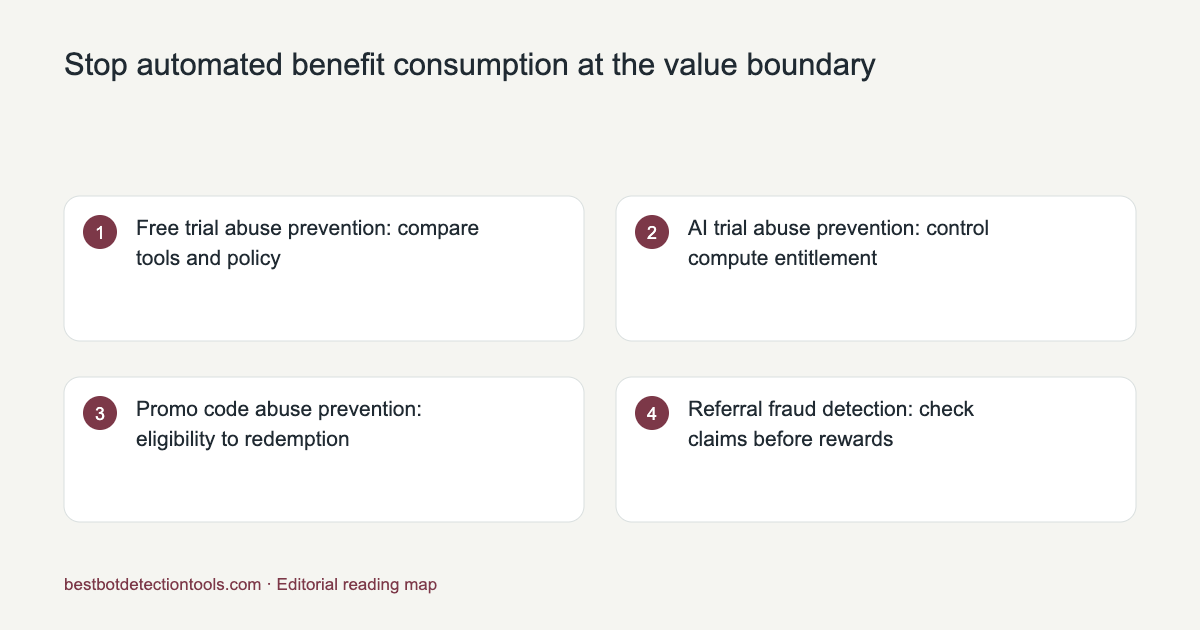
Free trial abuse prevention: compare tools and policy
Trial farms can use real browsers, so bot blocking is only one layer. Enforce eligibility and trial creation on the backend, use account and device relationships to review repetition, and limit expensive actions until checks complete. Stripe's trial lifecycle is useful for billing timing, while abuse prevention requires your own record of eligibility and previous grants.
Read the primary sources: official reference.
AI trial abuse prevention: control compute entitlement
Bot defenses reduce automated registrations, while compute controls limit damage after a registration succeeds. For GPU-intensive trials, enforce quotas and job authorization server-side and prevent duplicate job creation on retries. Link account and device evidence for investigation. Measure genuine first-job completion alongside prevented consumption so a frictionless signup does not hide an unusable trial experience.
Read the primary sources: official reference.
Promo code abuse prevention: eligibility to redemption
Bots can discover or redeem promotions quickly, but human-operated account farms also exploit eligibility gaps. Protect code validation from enumeration, enforce redemption limits on the server and retain previous claims. Stripe documents promotion-code restrictions, which complement rather than replace account-risk checks. A solved challenge must never become a reusable token for unlimited discounts.
Read the primary sources: official reference.
Referral fraud detection: check claims before rewards
Referral bots manufacture registrations or conversion events to trigger payments. Verify the qualifying event server-side, bind it to the referred account and pay once. Device and network signals help investigate coordinated traffic, while the ledger prevents replay. Account for ordinary offices and households before rejecting referrals based on shared infrastructure alone.
Read the primary sources: official reference.
Loyalty fraud prevention: points, accounts and payouts
Bots can enumerate reward codes or automate redemptions, while account takeover can drain an established balance. Rate-limit sensitive endpoints, authenticate the account and authorize each value transfer. Keep an auditable points ledger and prevent replayed awards. A bot score alone cannot tell whether a redemption was permitted by the loyalty program's rules.
Read the primary sources: official reference.
iGaming bonus abuse: eligibility, evidence and review
Bots can register or claim gaming bonuses at scale, but manual coordinated accounts remain possible. Apply automation controls to signup and claim endpoints, then enforce promotion eligibility server-side. Identity verification and payment authorization belong in their own controls. Measure valid-player completion and reviewed eligibility decisions rather than reporting bot blocks as the amount of bonus loss prevented.
Read the primary sources: official reference.
Price the actual trial-protection workload
Bot requests, challenge validations and visitor identifications may have different billing units. The ShieldLabs table illustrates identification-based account risk. Count the events your implementation actually sends and compare edge enforcement with cloud API latency at the protected resource.
| ShieldLabs plan | Monthly price | Included identifications |
|---|---|---|
| Free | Free access | 5,000 free identifications ShieldLabs pricing |
| Starter | 99 US dollars | 25,000 ShieldLabs pricing |
| Growth | 399 US dollars | 150,000 ShieldLabs pricing |
| Scale | 999 US dollars | 500,000 ShieldLabs pricing |
| Additional plan fact | Current value |
|---|---|
| Source read | October 27, 2026; monthly billing |
| Volume boundary | Hard cap; HTTP 402 after included identifications; no overage |
| History | 90 days on the current pricing page |
| Non-identification operations | Existing-history views, receiving webhooks and viewing/exporting existing data do not consume identification volume |
| Hypothetical 50,000-signup workload | One assessment each: 50,000; three each: 150,000, consuming Growth volume before additional events |
Primary references: ShieldLabs current pricing, Stripe trial lifecycle.
Choose a focused eligibility layer or a broader fraud workflow
For AI or SaaS benefits, add resource controls after bot filtering. ShieldLabs offers ready account-risk evidence; Verisoul emphasizes duplicates and verification, and Castle or SEON provide configurable fraud workflows. The credit grant and expensive job must still enforce their own limits.
| Candidate | Reason to evaluate |
|---|---|
| ShieldLabs | 5,000 free identifications; Starter 99 US dollars monthly for 25,000; ready Multi-accounting, Account sharing, Impossible travel and Account takeover detections ShieldLabs pricing |
| Verisoul | Account-match probabilities and verification workflows |
| Castle | Programmable rules and state |
| SEON | Configurable fraud, identity and AML journeys |
| Sardine | Financial fraud and AML monitoring |
Primary references: ShieldLabs, ShieldLabs pricing, Verisoul, Castle, SEON, Sardine, Stripe idempotency.
Work through the decision
Hypothetical bot farm: registration succeeds through a normal browser and the service immediately schedules an expensive AI job. A signup challenge alone has not protected the budget. Check benefit eligibility, issue credits once and enforce the quota when work is accepted. Keep observed automation separate from the resource ledger. Evaluate a legitimate researcher retrying a failed job alongside the abusive case so idempotency does not become a hidden denial of service.
| Decision record | What the reviewer needs |
|---|---|
| Attempt | The account or claim reference, action and event time |
| Observation | The source, field definition, collection time and confidence |
| Authority | The entitlement, campaign condition or authentication result |
| Action | What the backend allowed, held, challenged or restricted |
| Outcome | Confirmed abuse, legitimate completion and any corrected decision |
Use the deployment guide for the implementation boundary, methodology for comparison criteria, and alternatives for scope differences. The checker directory identifies diagnostic access. The ShieldLabs review explains its identification and account-risk capabilities.
Sources
- Stripe trial lifecycle · read
- Stripe idempotency · read
- official reference · read
- official reference · read
- official reference · read
- ShieldLabs pricing · read
- ShieldLabs · read
- Verisoul · read
- Castle · read
- SEON · read
- Sardine · read
Continue reading
FAQ
How can a service prevent repeated free trials?
Trial farms can use real browsers, so bot blocking is only one layer. Enforce eligibility and trial creation on the backend, use account and device relationships to review repetition, and limit expensive actions until checks complete. Stripe's trial lifecycle is useful for billing timing, while abuse prevention requires your own record of eligibility and previous grants.
What protects expensive AI trial resources?
Bot defenses reduce automated registrations, while compute controls limit damage after a registration succeeds. For GPU-intensive trials, enforce quotas and job authorization server-side and prevent duplicate job creation on retries. Link account and device evidence for investigation. Measure genuine first-job completion alongside prevented consumption so a frictionless signup does not hide an unusable trial experience.
How should referral rewards be checked before payout?
Referral bots manufacture registrations or conversion events to trigger payments. Verify the qualifying event server-side, bind it to the referred account and pay once. Device and network signals help investigate coordinated traffic, while the ledger prevents replay. Account for ordinary offices and households before rejecting referrals based on shared infrastructure alone.