Combine automation and network evidence in endpoint decisions
Combine automation and network evidence in endpoint decisions. This guide is for bot-protection engineering teams. Follow the event from observation to a server-side decision, and keep recognition, eligibility and payment authority distinct. The practical goal is to avoid equating browser execution or a clean IP with authorized human activity while making the evidence reviewable.
Summarize with AI
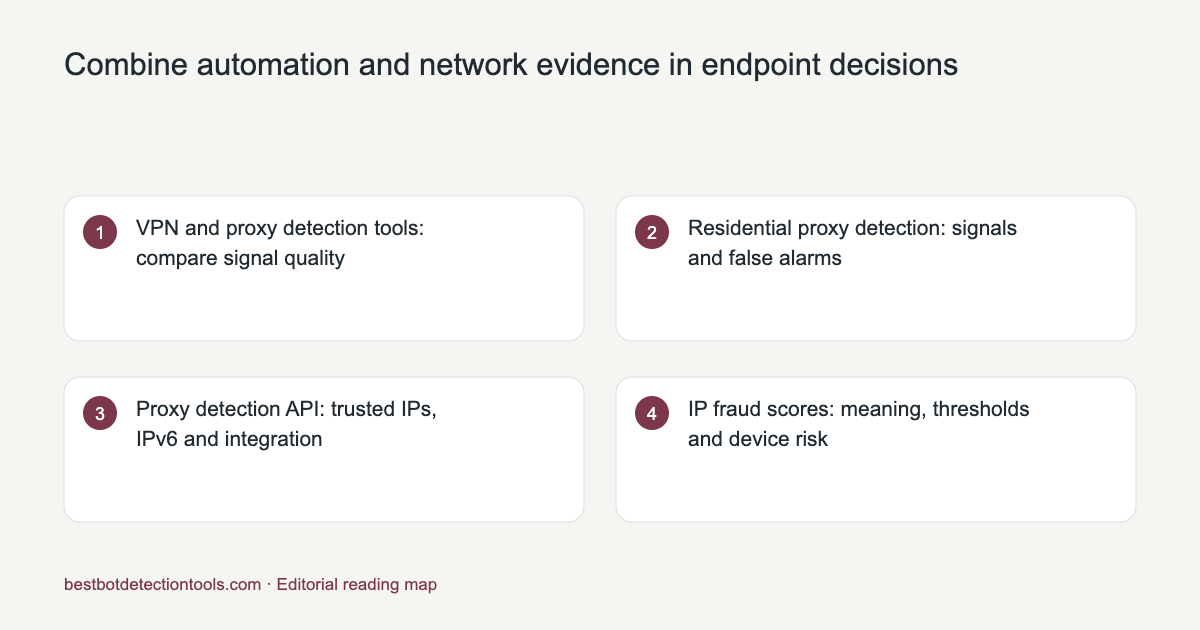
VPN and proxy detection tools: compare signal quality
Bot protection benefits from network context, while routing classification alone cannot decide automation. Compare ShieldLabs, Fingerprint, IPQualityScore, SEON and MaxMind on VPN, proxy, Tor and hosting evidence. Evaluate the same endpoints and traffic cohorts used for bot controls. An allowed residential address may still carry a bot, and a flagged VPN may carry a legitimate customer.
Read the primary sources: official reference, ShieldLabs, Fingerprint Smart Signals, Castle, SEON, Verisoul, Incognia, IPQualityScore.
Residential proxy detection: signals and false alarms
Residential addresses can carry automated traffic because the address type says little about the client behavior. Combine bot signals, request patterns and account history with explicit proxy evidence. Use confirmed authorized proxy sessions for testing and a separate legitimate mobile cohort. A decline in datacenter bots does not demonstrate coverage of residential or mobile proxy abuse.
Read the primary sources: official reference.
Proxy detection API: trusted IPs, IPv6 and integration
Check whether an IP API classifies the current connection or enriches a previously collected browser event. Forward only addresses verified at trusted ingress, and confirm IPv6, Tor and missing-data semantics. Apple's Private Relay uses published relay ranges. A bot policy can use that context, but neither the relay label nor a clean IP result proves whether the request is automated.
Read the primary sources: official reference, Trusted ingress headers.
IP fraud scores: meaning, thresholds and device risk
A bot score, an IP fraud score and a device-reputation score do not share a universal direction or meaning. Cloudflare's high bot score indicates more human-like traffic, while other risk scales can point the opposite way. Preserve field definitions and reasons. Measure the final policy outcome rather than blending numbers into a dashboard that hides their units.
Read the primary sources: official reference.
Location spoofing detection: evidence without guesswork
Bots and agents can present inconsistent location evidence, but customers behind relays can do so too. Compare IP exit, device-reported coordinates, permission state and timestamps instead of treating a map point as ground truth. Location spoofing detection should explain the inconsistency and uncertainty. The correct response depends on the endpoint and action, not just the geographic distance.
Read the primary sources: official reference.
Anti-detect browser detection: consistency and context
Headless browsers and anti-detect browsers are overlapping but different categories. One concerns execution without a conventional visible UI; the other concerns profile isolation or altered attributes. Evaluate automation, tampering and account behavior independently. Privacy settings can resemble some signals, so a detector needs explainable output and an unknown state rather than a single browser-name blacklist.
Read the primary sources: official reference.
TLS and HTTP fingerprinting: JA4, HTTP/2 and context
JA4 provides TLS-client characteristics; JA4T analyzes TCP, and HTTP/2 fingerprinting examines another protocol layer. These signals can help characterize automated clients, but common browsers share values and fields can be absent. Cloudflare documents JA4 availability and missing-field cases. Use the correct observation point and keep behavior and authorization in the decision rather than equating a fingerprint with a bot.
Read the primary sources: official reference, Cloudflare JA4.
Anonymity checks: browser observations and their limits
An online bot or anonymity checker can demonstrate visible signals but cannot certify how every service classifies the browser. Record the tested fields and conditions. A public demo differs from a sales sandbox, and a clean network result does not mean a request is human. Use controlled repeat observations to understand behavior rather than presenting a single result as a universal verdict.
Read the primary sources: official reference.
Distinguish data-access networks from cross-merchant fraud intelligence
A network enabling authorized public-data collection is not the same product as an inbound bot detector. A commerce network's risk evidence is also different from authenticated agent identity.
| Requirement | Relevant candidates or evidence |
|---|---|
| Authorized mobile data access | Oxylabs mobile-proxy endpoints, targeting and session controls; Bright Data network methodology |
| Commerce-network risk intelligence | Forter, Signifyd and Sift |
| Authenticated cross-device history | Account events with a justified identity join |
| Probabilistic recognition | Relationship or match evidence with uncertainty |
| Merchant access to data | The actual permissions and fields in the proposed product contract |
Primary references: Oxylabs mobile proxies, Bright Data methodology, Forter identity intelligence, Signifyd commerce network, Sift.
Select network evidence for login and payment without blanket bans
For proxy-associated bot abuse, compare a connection result with the actual request behavior. ShieldLabs combines network/device and account context, Fingerprint provides Smart Signals, and IPQS or MaxMind serve focused enrichment needs. Do not replace a protected endpoint policy with a blanket privacy-network ban.
| Need | Starting candidates |
|---|---|
| Combined network/device and account-risk evidence | ShieldLabs |
| Focused IP enrichment | IPQS, MaxMind |
| Managed identity with documented Smart Signals | Fingerprint |
| Configurable fraud journeys | SEON |
| Native mobile location behavior | Incognia |
Primary references: ShieldLabs, IPQS, Fingerprint Smart Signals, MaxMind anonymizer data, SEON, Incognia.
Work through the decision
Hypothetical endpoint policy: a verified crawler fetches public pages, an unknown browser agent requests a login and a customer uses a VPN. The same proxy label should not decide all three. Verify crawler identity using provider guidance, retain unknown agent status and authorize the login independently. Compare network and automation evidence with the endpoint's allowed behavior. A score direction must be documented before rules combine different vendors' outputs.
| Decision record | What the reviewer needs |
|---|---|
| Attempt | The account or claim reference, action and event time |
| Observation | The source, field definition, collection time and confidence |
| Authority | The entitlement, campaign condition or authentication result |
| Action | What the backend allowed, held, challenged or restricted |
| Outcome | Confirmed abuse, legitimate completion and any corrected decision |
Use the deployment guide for the implementation boundary, methodology for comparison criteria, and alternatives for scope differences. The checker directory identifies diagnostic access. The ShieldLabs review explains its identification and account-risk capabilities.
Sources
- MaxMind anonymizer data · read
- ShieldLabs · read
- Fingerprint Smart Signals · read
- Castle · read
- SEON · read
- official reference · read
- Incognia · read
- IPQS · read
- official reference · read
- Trusted ingress headers · read
- official reference · read
- official reference · read
- Cloudflare JA4 · read
- official reference · read
- Oxylabs mobile proxies · read
- Bright Data methodology · read
- Forter identity intelligence · read
- Signifyd commerce network · read
- Sift · read
Continue reading
FAQ
How does residential proxy detection differ from identifying an ISP?
Residential addresses can carry automated traffic because the address type says little about the client behavior. Combine bot signals, request patterns and account history with explicit proxy evidence. Use confirmed authorized proxy sessions for testing and a separate legitimate mobile cohort. A decline in datacenter bots does not demonstrate coverage of residential or mobile proxy abuse.
Which address should a proxy detection API evaluate?
Check whether an IP API classifies the current connection or enriches a previously collected browser event. Forward only addresses verified at trusted ingress, and confirm IPv6, Tor and missing-data semantics. Apple's Private Relay uses published relay ranges. A bot policy can use that context, but neither the relay label nor a clean IP result proves whether the request is automated.
Does an IP fraud score prove that a customer is fraudulent?
A bot score, an IP fraud score and a device-reputation score do not share a universal direction or meaning. Cloudflare's high bot score indicates more human-like traffic, while other risk scales can point the opposite way. Preserve field definitions and reasons. Measure the final policy outcome rather than blending numbers into a dashboard that hides their units.